

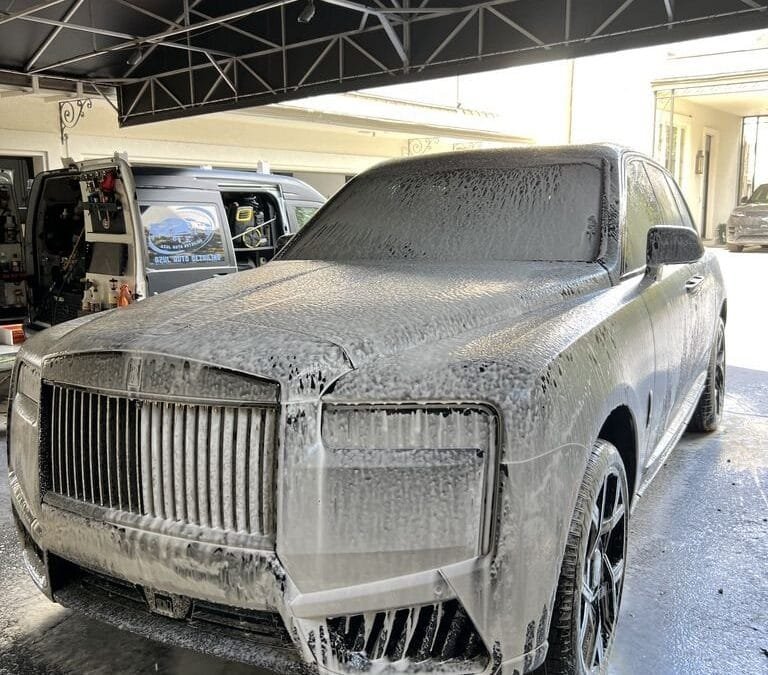
If you've driven I-45, the Beltway or the Grand Parkway in May or September, you've probably met them: the small black flies that end up spread across your front bumper, hood, mirrors and windshield. Lovebug season comes around twice a year, and it's worth taking seriously, because what they leave behind isn't just unsightly. It can damage your paint.
When is lovebug season in Houston?
Twice a year. According to the Texas A&M Forest Service, Texas has two generations of lovebugs each year, with adults emerging in May and September. That's why the fronts of cars around Houston suddenly look peppered with bugs at the same time every spring and every fall.
For most drivers, the September flight is the one that catches them off guard. It arrives while the weather is still hot, and after a summer of normal driving, few people are thinking about bugs until the bumper is covered.
Why lovebugs are harder on paint than ordinary bugs
The same Texas A&M Forest Service guidance puts it plainly: lovebugs have slightly acidic body fluids that will damage paint if they aren't removed within a few days. That's the part most people don't realize. The bug itself isn't the problem; what it leaves on the surface is.
Your car's shine comes from its clear coat, the transparent top layer of the paint. On a typical factory finish, that layer is only about 35 to 50 microns thick, thinner than a sheet of printer paper. Residue left sitting on it can etch into that layer and leave dull marks with defined edges that don't wash off. Houston's heat doesn't help: the city averages roughly 102 days a year at or above 90°F, and heat is known to speed up etching from bird droppings. There's no reason to give bug residue the same head start.
What to do during bug season
The single most useful habit is simple: don't let them sit. A few days is the window the Texas A&M guidance gives, so the sooner the better.
- Wash the front of the car often while the flight lasts. Bumper, hood, mirrors, grille and glass collect most of them.
- Rinse first, then wash. Loosen and flush residue with water before anything touches the paint.
- Don't scrub or wipe dry bugs off dry paint. Wiping dusty or dry paint is one of the easiest ways to add fine scratches and swirls. Use a pH-neutral car shampoo and a clean wash mitt instead.
- Dry with clean, soft microfiber. Houston's city water is hard, so don't leave it to dry on the paint in the sun, or you can trade bug marks for water spots.
- Skip the automatic brush wash. It removes bugs by dragging grit across the paint, which is how swirl marks start.
If you already have paint protection on the car, keep going with the same routine. Protection makes residue easier to wash off; it doesn't make it harmless to leave in place.
When a wash isn't enough
After the first few highway trips of the season, most cars need more than a quick rinse. That's where a professional exterior detail helps, done at your home or office, with our own water and power.
Every Azul Exterior Detail includes a hand wash, wheels and tires, exterior glass and light bug removal, finished with the Gloss Reset: a paint sealant that protects for up to 3 months. It starts at $139 for a sedan or coupe, $159 for an SUV or small truck and $179 for an XL SUV or 3-row vehicle, before applicable tax.
If your paint also looks flat after a summer in the sun, Wash & Polish (Paint Enhancement) adds paint decontamination and one machine polish for gloss, finished with a ceramic wax/sealant that protects for up to 6 months. It starts at $359.
Heavy bug build-up is priced from photos. Everyday bugs and road film are included in both packages. A front end caked from a long highway drive in peak season takes more time and product, so text us photos first and we'll confirm the price before we arrive. Nothing extra is added without your approval.
What if the bugs have already left marks?
If you've washed the car and still see dull, defined spots where bugs were, they may have etched the clear coat. Here's the honest answer on what can be done:
- Light etching can often be reduced or removed with paint correction, which levels the clear coat with a machine polisher instead of filling or hiding the mark.
- Deep etching may only improve. We won't promise it will disappear, because it depends on how far into the clear coat it goes and how much clear coat your paint can safely give up.
That's why every Azul paint correction starts with paint-thickness readings and a test section you see before we do the whole car. Paint correction starts at $549 for One-Step, and the photo assessment is free.
Want the next bug season to be easier?
A multi-year ceramic coating helps against bird droppings, sap and bugs, and makes washing them off easier when the May and September flights come around. It doesn't make paint immune, and it still needs regular, correct washing. Azul's coating packages start at $895.
Not sure what your paint needs?
Send us photos. Text 4–6 photos to 713-386-9945: the front of the car in daylight, plus close-ups of the worst areas. We'll tell you whether an Exterior Detail will take care of it, whether heavy build-up needs a quote, or whether you're looking at etching that needs correction. The photo assessment is free, with no obligation.